 1.855.272.3889
  1.365.697.5889
 Understanding Aluminum Coil Grades and What Manufacturers Need to Know Before Ordering
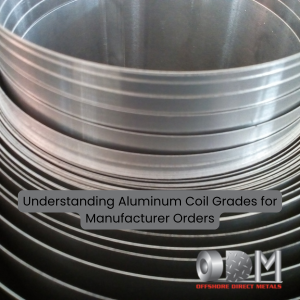
Choosing the right aluminum coils starts with understanding what grade, temper, finish, and thickness your application actually needs. For manufacturers, this decision affects forming, strength, corrosion resistance, appearance, coating performance, fabrication time, and final product quality. A material that works well for one product may be too soft, too stiff, too reactive, or too difficult to finish for another. That is why ordering from the right aluminum coil suppliers is not only about availability or price. It is about matching the material to the way it will be used.
Before placing an order, manufacturers look at how the aluminum will be cut, bent, stamped, painted, formed, or exposed to the environment. The more specific you are up front, the easier it is to mitigate waste, production delays, and materials that do not perform the way you expected. At Offshore Direct Metals (OD Metals), North America and the Caribbean’s leading supplier of aluminum coils, extrusions, and other components, we open communication with our customers to ensure precision results that perform in the applications you need.
Why Aluminum Coil Grade Matters
An aluminum grade tells you about the alloy composition and general performance of the material. Different grades contain different elements, which change how the metal behaves. Some grades are more formable, some are stronger, some resist corrosion better, and some are better suited for decorative or coated applications.
For manufacturers, the wrong grade can create problems quickly. Material may crack during bending, fail to hold its shape, corrode faster than expected, or reject coatings during finishing. Even if the coil looks right when it arrives, issues may not appear until production begins.
This is why manufacturers should treat grade selection as an engineering and production decision, not just a purchasing decision.
Common Aluminum Coil Grade Considerations
While the right grade depends on the application, there are a few general categories manufacturers often compare.
Commercially pure aluminum grades are often chosen when formability and corrosion resistance matter more than high strength. These materials can be useful for light-duty products, decorative components, and applications where the metal needs to be shaped easily.
- 3000 series grades are commonly used when manufacturers need a balance of formability, corrosion resistance, and moderate strength. They are often selected for panels, enclosures, cladding, roofing components, signage, and general sheet metal work.
- 5000 series grades are often considered when corrosion resistance is especially important, including exterior, marine-adjacent, transportation, and exposed applications. These grades may offer better strength than some softer options while still supporting fabrication needs.
The key is not to memorize every alloy. The key is to explain your application clearly so the supplier can help you narrow down the best option.
Temper Is Just as Important as Grade
Grade is only part of the decision. Temper describes how the material has been processed and how hard or soft it is. Two coils with the same alloy can behave very differently if they have different tempers.
A softer temper may bend and form more easily, which can be helpful for deep forming, tight bends, or complex shapes. A harder temper may provide better strength or stiffness, but it may also be more likely to crack if the bend radius is too tight.
Before ordering aluminum coils, manufacturers should confirm how the material will be processed. Will it be stamped? Roll formed? Cut into blanks? Bent into corners? Painted? Exposed outdoors?
These details help determine whether the temper supports the production process.
Thickness, Width, and Tolerance
Thickness and width seem straightforward, but they can affect cost and performance. Material that is too thin may not provide enough strength or rigidity. Material that is too thick may increase weight, cost, and forming difficulty.
Tolerance is also important. If your equipment requires consistent feeding, cutting, bending, or roll forming, small variations can affect production. Manufacturers should confirm acceptable tolerances before ordering, especially for high-volume production or automated lines.
If the coil will be slit, cut, or processed again, it is also important to think about edge quality, coil weight, inside diameter, outside diameter, and packaging requirements. These practical details can affect how easily the material moves through your facility.
When Are Painted Aluminum Coils a Good Idea?
Painted aluminum coils can be a smart choice when manufacturers need colour, protection, and production efficiency in one material. Instead of fabricating bare material and coating it afterward, pre-painted coil can arrive ready for forming and finishing steps.
This can reduce labour, improve consistency, and support applications where appearance matters. Painted aluminum coils are often used for building products, signage, trim, panels, enclosures, and other visible components.
Before ordering, manufacturers should confirm the coating system, colour requirements, gloss level, film thickness, substrate grade, and whether the coating can handle the forming process. Some coatings are better suited for exterior exposure, while others may be used for indoor or decorative applications.
Why Support from Your Supplier Matters
Working with knowledgeable aluminum coil suppliers helps manufacturers avoid costly mistakes. A strong supplier can help review drawings, discuss performance needs, explain grade and temper options, and identify whether a standard option or a more specialized order makes sense.
The same applies when manufacturers work with aluminum extrusion suppliers on projects that combine sheet, coil, and extrusion components. If one part of the assembly is made from coil and another from extrusion, material compatibility, finish matching, and production timing all become important. Coordinating with experienced suppliers can help keep the full project aligned.
Good suppliers should be able to ask practical questions. What is the end use? Will the material be exposed to moisture or chemicals? Will it be painted, bent, or roll formed? Are there tight dimensional requirements? Is appearance critical? These questions help prevent ordering based only on price.
What to Confirm Before Ordering
Before placing an order, manufacturers should confirm:
- Alloy grade
- Temper
- Thickness and width
- Tolerance requirements
- Surface finish
- Coating or paint requirements
- Coil weight and dimensions
- Packaging needs
- End-use environment
- Fabrication method
- Delivery timeline
This information gives your supplier a clearer picture of what the material needs to do. It also makes quoting more accurate and helps reduce the chance of receiving material that cannot be used efficiently.
Avoiding Common Ordering Mistakes
One common mistake is choosing a grade based only on what is available quickly. Fast availability matters, but it should not override performance. Another mistake is assuming one aluminum material can be substituted for another without testing. Even small changes in grade, temper, or coating can affect forming and final product quality.
Manufacturers should also avoid waiting until production starts to test material behaviour. If a new grade, coating, or supplier is being used, samples or small trial runs can help identify issues before a full production order is placed.
Build Better Products with Better Material Planning and OD Metals
Ordering aluminum is not only a purchasing task. It is part of the manufacturing process. The right aluminum coil can improve consistency, reduce waste, support efficient fabrication, and help the finished product perform as expected.
By understanding grade, temper, coating, and supplier support, manufacturers can make more confident decisions before ordering. Whether the project involves painted products, building components, equipment parts, or custom assemblies, choosing the right material from the start can save time, control costs, and improve long-term quality.
When manufacturers work with experienced aluminum extrusion suppliers and coil partners, like OD Metals, you can better align materials across the full project. That kind of planning helps prevent production problems and supports stronger, more reliable finished products.